Colors of Hmông ethnic traditional crafts

ĐBP - Within the framework of the 4th Hmông Ethnic Cultural Festival, taking place from October 9 to 11 in Điện Biên, localities have brought forth craft demonstration spaces rich in identity. Every product and practical maneuver contributes to showcasing the cultural beauty and vitality of handicrafts preserved across generations by the Hmông people.

At the pattern embroidery demonstration space, deft hands swiftly guide needles, connecting threads into vibrant motifs against fabric backdrops. Each locality brings distinct touches to the festival in terms of color coordination and pattern shaping, reflecting the diverse costume culture of the Hmông people across different regions.

Artisan Sùng Thị Xoa (right) demonstrates the pattern embroidery art of the Hmông people in Lào Cai.

Introducing her locality's traditional embroidery craft, artisan Sùng Thị Xoa from Lào Cai province shared that embroidery motifs on Hmông attire in Lào Cai carry distinctive features, vividly reflected through color coordination leaning toward bright tones, notably yellow, red, and white. These contrasting color schemes make the patterns more eye-catching, establishing a distinct hallmark for the garments. Through the choice of colors and designs, viewers can perceive the rich aesthetics and dress customs of the Hmông community across various areas.

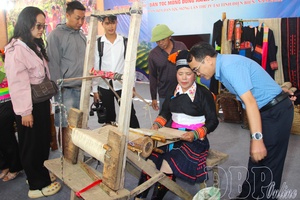
While embroidery shapes beauty through every stitched line, linen weaving begins with an unadorned material long associated with Hmông life. At the product display space of the Hợp Tiến Traditional Linen Production Cooperative from Lùng Tám commune, Tuyên Quang province, natural flax fiber products captured the attention of visitors. Journeying from raw material to a finished textile is a comprehensive process demanding labor, dexterity, and trade experience from craftspeople.

Sùng Thị Dính introduces traditional handwoven textiles to visitors.

Sùng Thị Dính, head of the cooperative's pattern design and embroidery team, shared: “To craft a finished linen fabric, one must go through multiple stages, from processing flax stems and spinning thread to weaving fabric and embroidering decorative motifs. Every stage demands perseverance, meticulousness, and craft experience. Bringing linen weaving to the festival is therefore not merely about introducing products, but about helping visitors engage more closely with a handicraft intimately tied to the daily life and cultural identity of the Hmông people.”

A prominent highlight within Điện Biên province's traditional craft demonstration space is the crafting of the Hmông panpipe (khèn). Participating in the demonstration are two artisans alongside experienced individuals possessing deep knowledge of Hmông musical instrument craftsmanship. The artisans sequentially inspect raw materials, process individual components, treat pipe tubes, and assemble them into a cohesive whole. Every motion requires careful precision, as a single misalignment at a joint or within the sound-producing reed can compromise the acoustic quality of the finished panpipe.

Meritorious Artisan Hậu Phái Sếnh (right) and delegation members demonstrate Hmông panpipe crafting.

Past the age of 60, the hands of Meritorious Artisan Hậu Phái Sếnh remain agile among bamboo tubes, wooden blocks, and copper plates to fashion Hmông panpipes. Meritorious Artisan Hậu Phái Sếnh noted: unlike products whose value is recognized primarily through shape and color, the khèn requires the craftsman to master its sound. The pipe tubes must be properly selected, shaped, and positioned; the reed must be crafted with care so the tone emerges clear, resonant, and harmonious. After assembly, the maker must test the sound, listen, and tune as necessary. Making a khèn is therefore not solely manual labor; it demands a discerning ear and experience distilled through numerous crafting cycles.

The Hmông ethnic musical instrument crafting demonstration space of Cao Bằng province.

Alongside Điện Biên, the provinces of Đắk Lắk, Thái Nguyên, and Cao Bằng also selected Hmông panpipe crafting to demonstrate at the festival. Each locality features its own practices, experience, and distinct approach to preserving the trade, contributing diversity to the demonstration area.

Artisans demonstrating and practicing traditional crafts on site makes the exhibition space vibrant, offering opportunities for craft practitioners to meet and share experience. At the same time, it helps visitors gain closer insight into the process of creating musical instruments closely entwined with Hmông cultural life. Mùa Thị Ký, a visitor from Phú Thọ province, shared: “Seeing artisans embroider patterns, weave textiles, and craft panpipes with my own eyes, I understand better the intricate workmanship behind each traditional craft. Demonstrations like this are very engaging, helping tourists not only admire products but also learn how makers craft them.”

Tourists learn about the traditional flax-fiber linen weaving craft of the Hmông people.

Through exhibition and performance activities, the festival not only provides residents and tourists with intuitive experiences of Hmông traditional crafts, but also raises awareness of preserving and passing down folk knowledge. From flax fibers and embroidery stitches to panpipe melodies, cultural values preserved by the hands, experience, and pride of artisans continue to be introduced and disseminated in contemporary life.

Thu Hằng
Comment

You have 500/500 characters left

Please enter 5 or more characters!!!

Recent news

  • 'Colors of Hmông ethnic traditional crafts

    Colors of Hmông ethnic traditional crafts

    CULTURE - SPORTS -
    ĐBP - Within the framework of the 4th Hmông Ethnic Cultural Festival, taking place from October 9 to 11 in Điện Biên, localities have brought forth craft demonstration spaces rich in identity. Every product and practical maneuver contributes to showcasing the cultural beauty and vitality of handicrafts preserved across generations by the Hmông people.
  • 'The joy of a grand cultural celebration

    The joy of a grand cultural celebration

    CULTURE - SPORTS -
    ĐBP - The lively sound of the Hmông khèn flute echoes through the mountains and forests of Điện Biên, blending with the excitement building ahead of the 4th Hmông Ethnic Culture Festival 2026. Artisans rehearse with passion, while villagers bustle about preparing to welcome visitors. Behind the flute’s rich, haunting melodies lies pride in ethnic identity and a heartfelt invitation to friends and travelers to join in the festivities.
  • 'Exciting sports competitions at 4th Hmông Ethnic Cultural Festival

    Exciting sports competitions at 4th Hmông Ethnic Cultural Festival

    CULTURE - SPORTS -
    ĐBP - Within the framework of the 4th Hmông Ethnic Cultural Festival, sporting events officially kick off on October 9. At this point, athletes from participating delegations are swiftly stabilizing their contingents, checking registration dossiers, and preparing uniforms and equipment, looking forward to spirited competitions.
  • 'Honoring cultural identity of Hmông ethnic group

    Honoring cultural identity of Hmông ethnic group

    CULTURE - SPORTS -
    ĐBP - The 4th Hmông Ethnic Cultural Festival in 2026 takes place from October 9 to 11 in Điện Biên province. Nearly 800 artisans, performers, and athletes from 11 provinces - including Tuyên Quang, Phú Thọ, Thái Nguyên, Sơn La, Cao Bằng, Lào Cai, Thanh Hóa, Nghệ An, Đắk Lắk, Điện Biên, and Lai Châu - gather together. This is not only a cultural celebration, but also an occasion to affirm the enduring vitality of ethnic identity within the nation’s developmental stream.
  • 'Hmông people take charge of their tourism future

    Hmông people take charge of their tourism future

    TRAVEL -
    ĐBP - Drawing on the cultural and natural assets embedded in everyday life, Hmông communities in Điện Biên province are gradually changing the way they think and work to develop community-based tourism. The transformation is reflected in their proactive efforts to improve their villages, preserve traditional culture and work together to protect the landscape and environment.
  • 'Bringing digital skills to Phình Giàng residents

    Bringing digital skills to Phình Giàng residents

    SOCIAL AFFAIRS -
    ĐBP - In Xa Vua village, Phình Giàng commune, smartphone usage is steadily becoming an ingrained part of residents’ daily lives. Moving beyond devices previously used merely for phone calls, many villagers now know how to install and activate VNeID electronic identification accounts, complete various administrative procedures online, and perform cashless payments.
  • 'From fire safety lessons to real-world skills for students

    From fire safety lessons to real-world skills for students

    SOCIAL AFFAIRS -
    ĐBP - To equip students with fire prevention and firefighting knowledge, as well as rescue and emergency response skills, the Fire Prevention, Firefighting and Rescue Police Division of the Điện Biên provincial Police has worked with schools to provide safety education, hands-on instruction and practical training for teachers and students.
  • 'Điện Biên ready for 2026 provincial defensive area exercise

    Điện Biên ready for 2026 provincial defensive area exercise

    NEWS - POLITICS -
    ĐBP - The 2026 Điện Biên provincial defensive area exercise is a vital political, national defense, and security mission of the province, aimed at elevating the leadership and managerial capacities of Party committees and authorities, as well as the advisory competence of provincial departments, boards, and sectors, with the armed forces serving as the core.
  • 'Making Điện Biên’s OCOP products more competitive

    Making Điện Biên’s OCOP products more competitive

    ECONOMY -
    ĐBP - Điện Biên province now has 157 OCOP products, including five four-star products made by the Hồng Kỳ International Coffee Joint Stock Company, the Hà Chung Coffee Processing Facility, and the Phan Thanh Ngọt Tea Processing and Trading Facility.